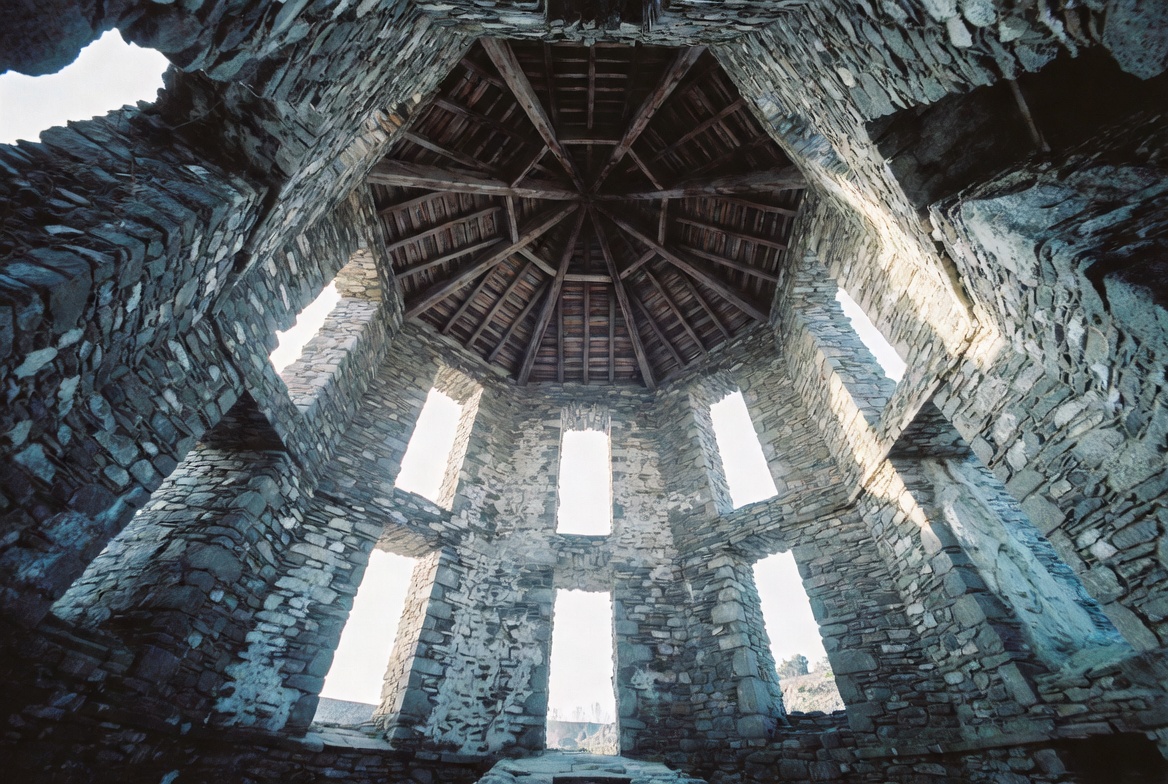
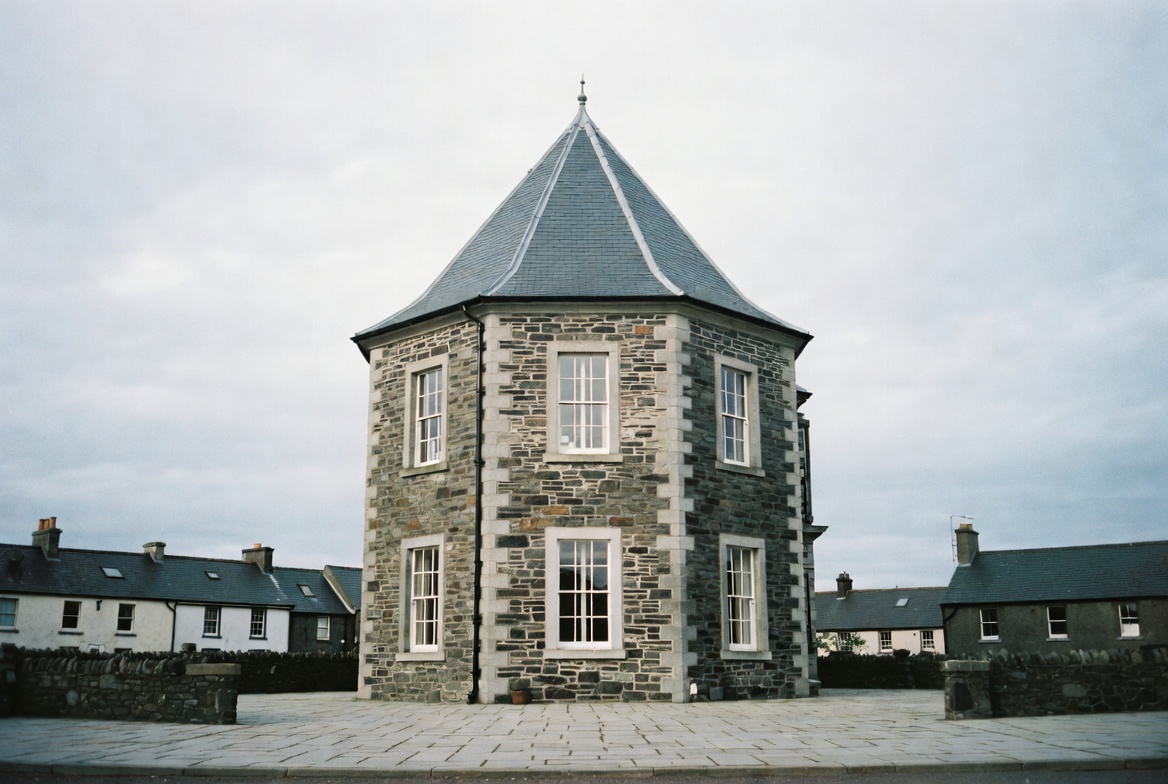
Nenagh's nineteenth-century county gaol stands at the eastern end of Banba Square, a small public space at the centre of the town. The cell wings are gone, demolished by the start of the twentieth century, but the octagonal Governor's House at the centre of the plan still stands — and is, for a building of its kind in Ireland, almost unique.
Bentham in Tipperary
The gaol was built between 1840 and 1842 to designs by the architect John Benjamin Keane. Keane drew explicitly on Jeremy Bentham's panopticon: a central inspection point from which a single warder could observe every cell at a glance, surrounded by radiating wings of glazed-front cells. Few gaols anywhere in Britain or Ireland were ever built strictly to Bentham's plan; Nenagh was one of them. The Governor's House, an eight-sided three-storey block at the heart of the site, was the inspection drum from which the warder watched.
The cell wings — five of them, of cut limestone with iron galleries — were demolished after the gaol's closure, and their stone reused locally in nineteenth-century housing. The square brick gate-lodge, with two arched entrances and a clock tower, also survives.
Famine and transportation
The gaol's busiest period was the famine decade. Sentences for petty theft, bread theft, vagrancy, and in some cases the deliberate breaking of prison windows — the last to gain admission for food and shelter — fill the magistrates' books between 1845 and 1851. From Nenagh, many convicts were transferred to the convict depots of Cork and Dublin, and from there transported to New South Wales or Van Diemen's Land.
Public hangings took place on a temporary scaffold above the gate from the 1840s through the 1860s. The last public execution at Nenagh — and one of the last in Ireland — was that of John Walsh in 1858 for the murder of his wife. By the 1870s the gaol's role had diminished; the county's prisoner traffic was being routed through the new larger prisons of Limerick and Dublin. The site closed in 1887.
The Heritage Centre
After 1887 the Governor's House passed through several civic uses, including as the offices of Nenagh Urban District Council. From 2002 it has housed the Nenagh and District Heritage Centre, with permanent exhibitions on the gaol itself, on local archaeology, and on the history of Tipperary's many monastic and military sites. The centre is open through the summer months. Admission is modest; the site is small but the architectural rarity of the building is its principal claim on visitors.
Notable inmates
- Famine-era convictsMany sent on to the great convict depots of Cork and Dublin
- John WalshLast man publicly executed at Nenagh, 1858
- Tithe-war prisonersHeld during the Tipperary disturbances of the 1830s and 1840s