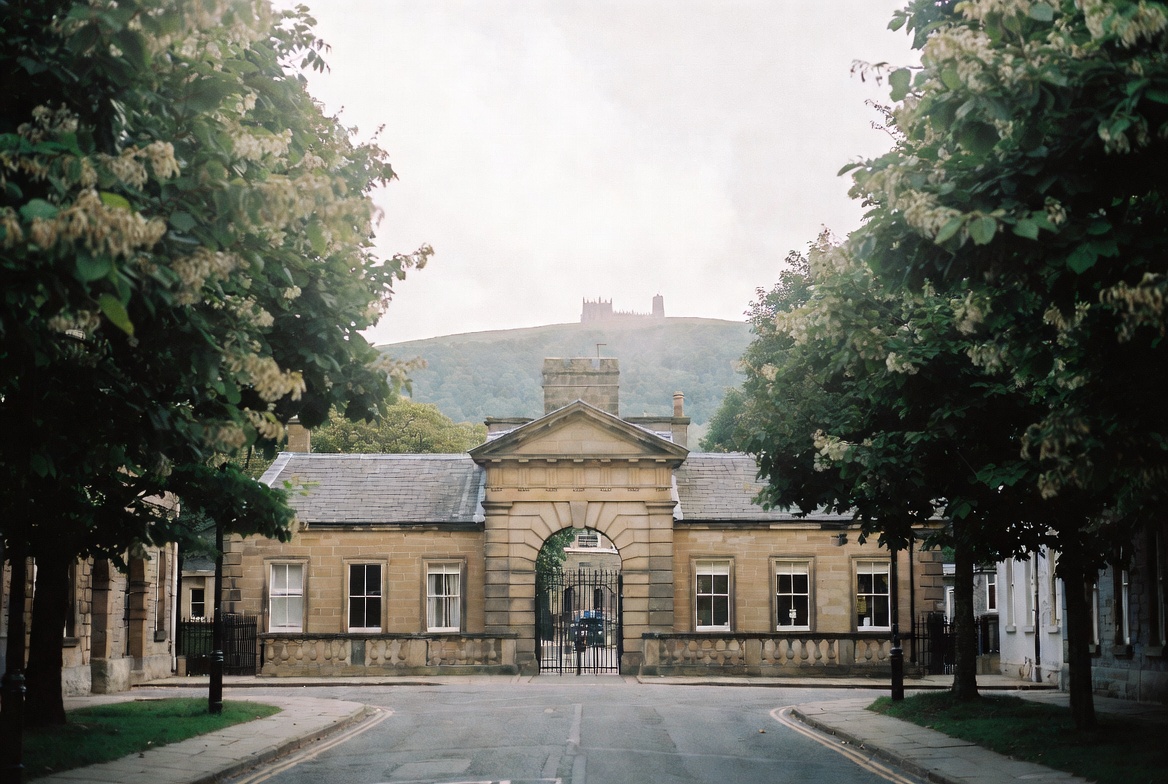
The Mall in Downpatrick is a wide tree-lined avenue rising toward Down Cathedral, the mediaeval church that stands above what tradition holds to be the burial place of Saint Patrick. The county gaol stood — and stands — at the foot of the avenue, a triangular block of fine cut sandstone with a low, classical gatehouse facing the road.
A reform-era county gaol
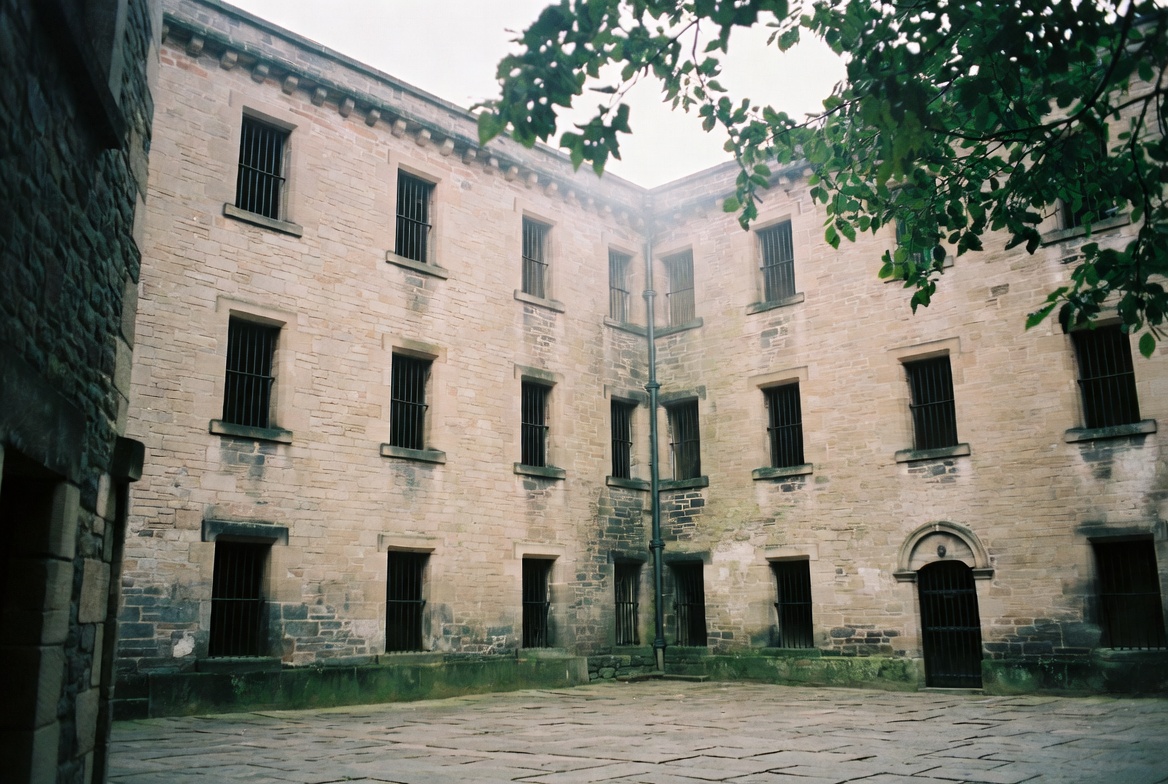
Construction of the new County Down Gaol began in 1789, in the same wave of late-Georgian reform that produced Kilmainham, and continued in stages until completion in 1796. The architect was Charles Lilly, a Dublin engineer associated with several Ulster public works of the period. Three radiating cell ranges met behind a polygonal Governor's House — an arrangement that reflected the early influence of Bentham's panopticon, while predating any full panopticon ever built in Ireland.
The exterior detailing was unusually refined for a county gaol. Hammer-dressed sandstone, classical pilasters at the gate, and a pediment above the central inspection block gave the building a civic, almost municipal appearance — at odds with the iron grilles inside.
Thomas Russell and 1803
The gaol's place in Irish memory rests largely on a single morning. Thomas Russell — librarian, United Irishman, and friend of Wolfe Tone — was arrested in September 1803 for his attempt to raise the north of Ireland in support of Robert Emmet's failed Dublin rising. He was tried in Downpatrick on 19 October and hanged at noon on 21 October at the gaol gate. His funeral sermon called him "the man from God knows where" — a phrase the poet Florence Wilson took, a century later, for the title of the ballad that fixed Russell's name in popular memory.
From gaol to museum
Downpatrick Gaol's life as a place of imprisonment was relatively short. By 1830 the operations of the county had been transferred to a larger gaol elsewhere; the Mall building passed first to a militia regiment and then to general public uses. Its grounds were partly built over in the nineteenth century, but the central Governor's House, the gatehouse, and one cell range survived intact.
From 1981 the council-run Down County Museum took over the surviving buildings as its permanent home; the museum opened to the public in 1986. Cells, the chapel, and the Governor's House are now exhibition spaces. The execution site at the gate is marked.
Notable inmates
- Thomas RussellUnited Irishman, hanged at the gate 21 October 1803
- James HopeWeaver and 1798 Rebellion organiser; held briefly
- 1798 prisonersNumerous after the rebellion in County Down
- Mary Ann McCracken's contactsHeld during her brother Henry Joy McCracken's prosecution in Belfast