In 1796 the Sheriff of Dublin opened a new county gaol on the western fringe of the city, on a high ridge above the River Camac. He called it, plainly, the New Gaol. The name did not last. Within a generation it was Kilmainham — the place from which the modern Irish state would, in time, take its name and its martyrs.
A late-Georgian county gaol
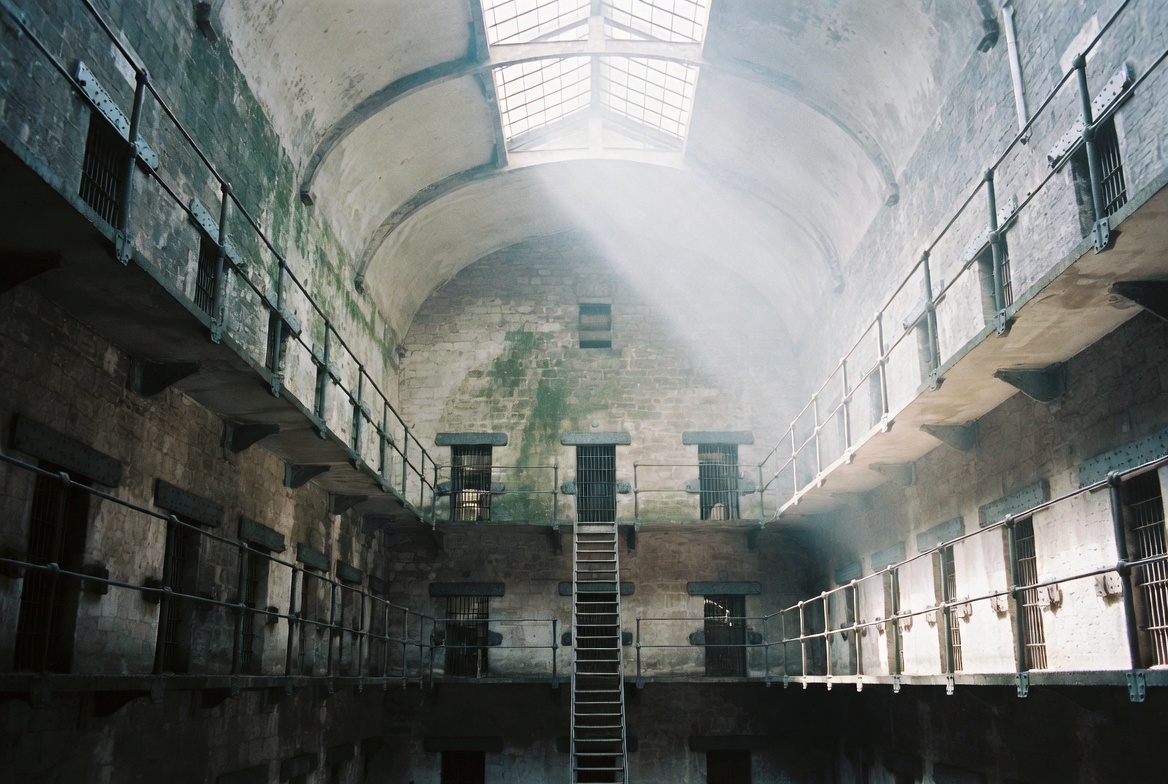
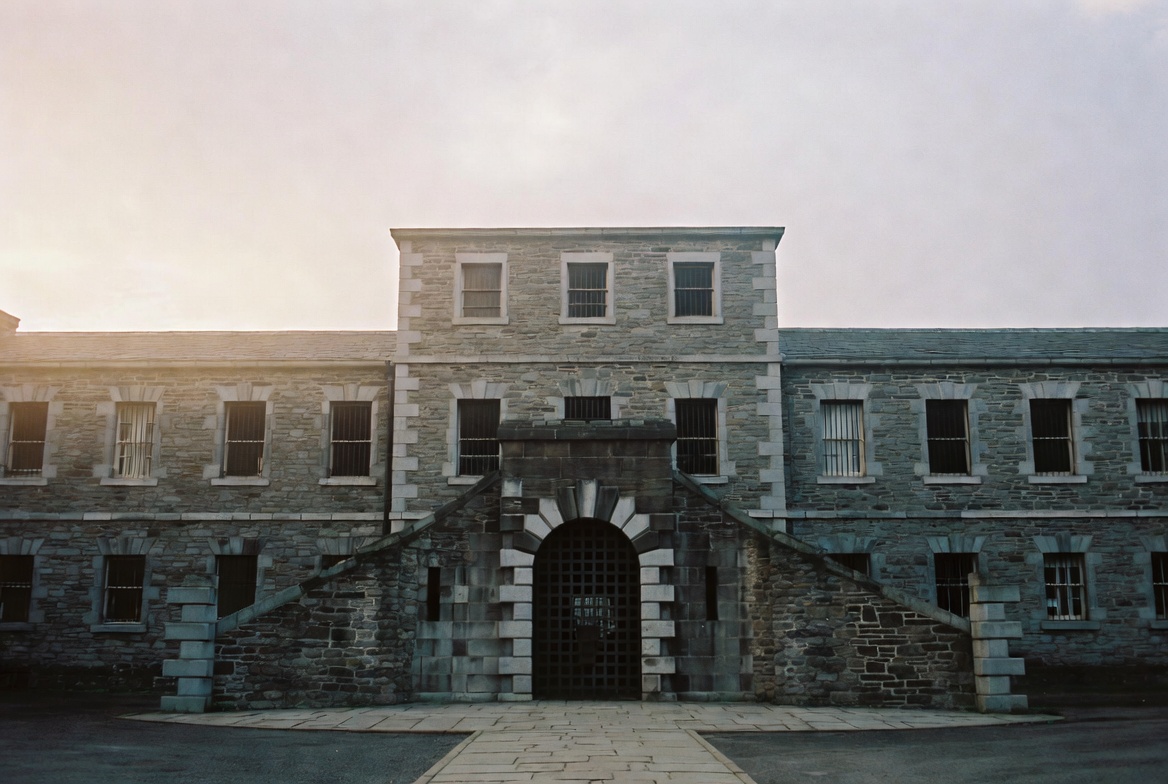
Kilmainham was a product of the late-eighteenth-century reform movement led by John Howard, whose surveys had condemned the squalor of older county prisons. The new building separated debtors from felons, men from women, and provided individual cells. The west wing, opened first, was the more austere; the great vaulted east wing, with its tiered iron walkways and central skylight, was added in 1864 to the design of John McCurdy. It is the east wing that visitors photograph today, and the one that has stood in for any number of cinematic nineteenth-century prisons.
For most of its working life Kilmainham was an ordinary county gaol. It held petty thieves, debtors, families convicted together during the Great Famine, and women whose offences were sometimes no more than vagrancy. By the 1840s, thirty cells had been added on the women's side to manage chronic overcrowding. The first executions inside the walls — by hanging, in public, against the prison's western face — date from the early years of the gaol.
The political prison
Kilmainham's political register opens in 1803, when Robert Emmet was held briefly here before his trial and execution. It runs through the Young Ireland generation of 1848, the Fenians of the 1860s, the Land League of the 1880s — Charles Stewart Parnell was confined in 1881–82 and signed the so-called Kilmainham Treaty with William Gladstone from his cell — and into the long, decisive decade of 1916–1923.
After the surrender of the General Post Office on 29 April 1916, the leaders of the Easter Rising were marched the few miles west to Kilmainham. Over thirteen days, fourteen of them were shot in the stonebreakers' yard at the rear of the prison. Patrick Pearse was the first, on 3 May. James Connolly, too injured to stand, was tied to a chair and shot on 12 May. Joseph Plunkett was married in the prison chapel to Grace Gifford on the night of 3 May; he was executed at three the next morning. The names of the rest — Clarke, MacDonagh, Daly, O'Hanrahan, Mallin, Heuston, Colbert, Kent, Ceannt, MacDermott — were read in successive editions of the morning newspapers, and the public mood in Ireland began to turn.
Hunger, civil war, and closure
During the Civil War, the new Irish Free State held its republican opponents in the same cells the British had used. Some 800 women were detained in Kilmainham in 1923. Mass hunger strikes erupted in October and November of that year and continued until December. The last political prisoner — Éamon de Valera, who had himself been held in the gaol after the Rising — walked out a free man on 16 July 1924. The prison was decommissioned a few weeks later.
For thirty-three years the building stood empty, its slates falling, its windows boarded. There was serious official discussion of demolition. A small civilian committee — the Kilmainham Gaol Restoration Society, formed in 1958 — eventually persuaded the state otherwise. From May 1960 a corps of voluntary labourers, many of them retired or unemployed, set about clearing the cells, repointing the stone, and rebuilding the chapel. The gaol opened to the public on 10 April 1966, the fiftieth anniversary of the Easter Rising.
Visiting today
Kilmainham is operated by the Office of Public Works as a national museum and is reached on foot from Heuston Station in fifteen minutes. Visits are by guided tour, in time-slot blocks, and tickets sell out. The east wing, the chapel, the corridors and the stonebreakers' yard are all on the route. The yard ends at a single Irish tricolour flying above a wooden cross — placed where, in successive May mornings of 1916, fourteen men were tied and shot.
Notable inmates
- Robert EmmetRevolutionary, held briefly 1803, hanged at Thomas Street
- Charles Stewart ParnellHeld 1881–82; signed the Kilmainham Treaty in his cell
- Patrick PearseExecuted 3 May 1916
- James ConnollyWounded; tied to a chair and shot 12 May 1916
- Joseph PlunkettMarried Grace Gifford in the chapel hours before his execution
- Éamon de ValeraHeld 1916 and 1923; the last political prisoner to leave the gaol, July 1924
- Constance MarkieviczSentenced to death 1916, commuted; later imprisoned again
- Grace GiffordHeld 1923; her cell-wall painting of the Madonna survives