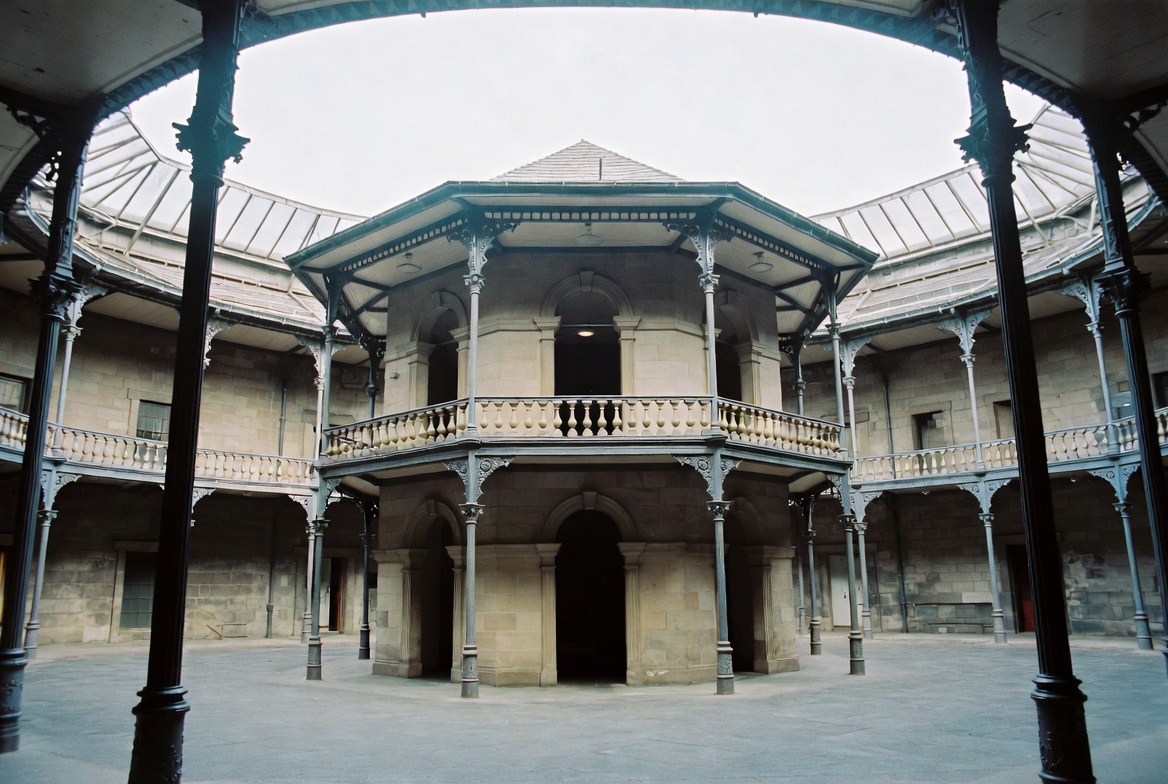
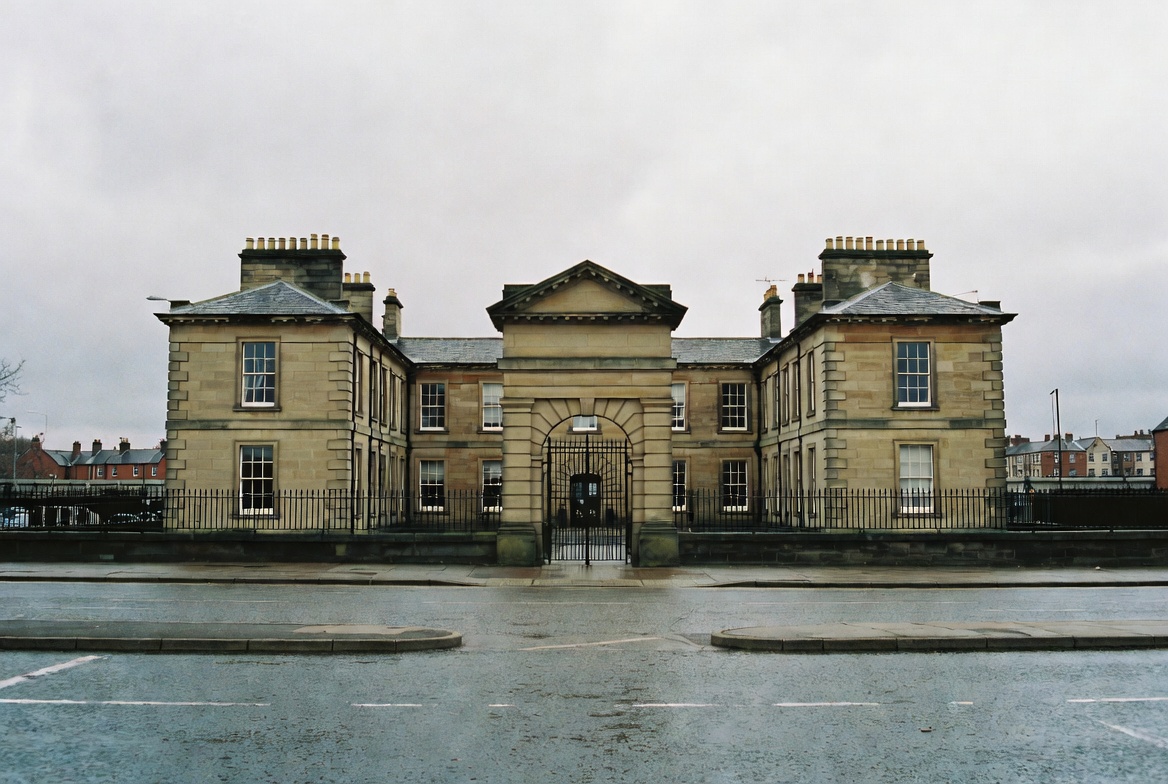
Crumlin Road Gaol stands across the road from the Crumlin Road Courthouse. The two buildings, designed as a single architectural set-piece by Sir Charles Lanyon in the 1840s, were connected by a brick-vaulted tunnel that runs beneath the road. For a hundred and fifty years, prisoners walked under the traffic, were tried in the courthouse, and walked back.
Lanyon's radial plan
Construction began in 1843 and the prison opened in 1846. Lanyon — already responsible for much of Victorian Belfast's public architecture — drew the plan partly from London's Pentonville (1842) and partly from Joshua Jebb's contemporary designs. Four cell wings radiated from a central drum called The Circle. A five-sided perimeter wall enclosed the whole, with watchtowers at each angle. Lanyon's gatehouse, in the same Italianate tradition as his other Belfast work, presents an austere, symmetrical front to the road.
The prison was designed to hold around 500 men. By the height of the Troubles, in October 1971, the Red Cross found 864 prisoners crammed into space planned for 475. Among them, in distinct and segregated wings, were loyalist and republican paramilitary inmates — a fact that gave the building's later folklore much of its weight.
The seventeen
Seventeen men were executed at Crumlin Road between 1901 and 1961. Most were hanged for murder; a small number were hanged for paramilitary offences. Tom Williams of the IRA was hanged here on 2 September 1942, aged nineteen, for the killing of a constable on Easter Sunday 1942. Robert McGladdery, executed on 20 December 1961 for the murder of Pearl Gamble, was the last person hanged in Northern Ireland. Capital punishment was effectively abolished there with the Northern Ireland (Emergency Provisions) Act 1973.
The Troubles
From 1969 the prison filled with men interned without trial under emergency legislation. Famous inmates of the period include Bobby Sands, Martin McGuinness, Ian Paisley, and Michael Stone — the building held leaders from every political constituency, often within a few metres of each other. Hunger strikes, mass escapes (most notably in 1971, when seven IRA prisoners scaled the wall) and tit-for-tat assaults were a feature of those decades.
The prison closed on 31 March 1996. The building stood derelict for sixteen years. After a programme of structural restoration it reopened as a visitor attraction in 2012, hosting tours, art installations, and — increasingly — concerts in the high vaulted central hall.
Notable inmates
- Éamon de ValeraHeld in 1924 during the closing months of the Civil War
- Tom WilliamsIRA member, hanged 2 September 1942 aged 19
- Bobby SandsHeld here before his transfer to the Maze, where he died on hunger strike
- Martin McGuinnessDetained on remand
- Ian PaisleyHeld briefly during civil-rights-era protests
- Robert McGladderyLast execution in Northern Ireland, December 1961
- Michael StoneHeld following the Milltown Cemetery attack of 1988