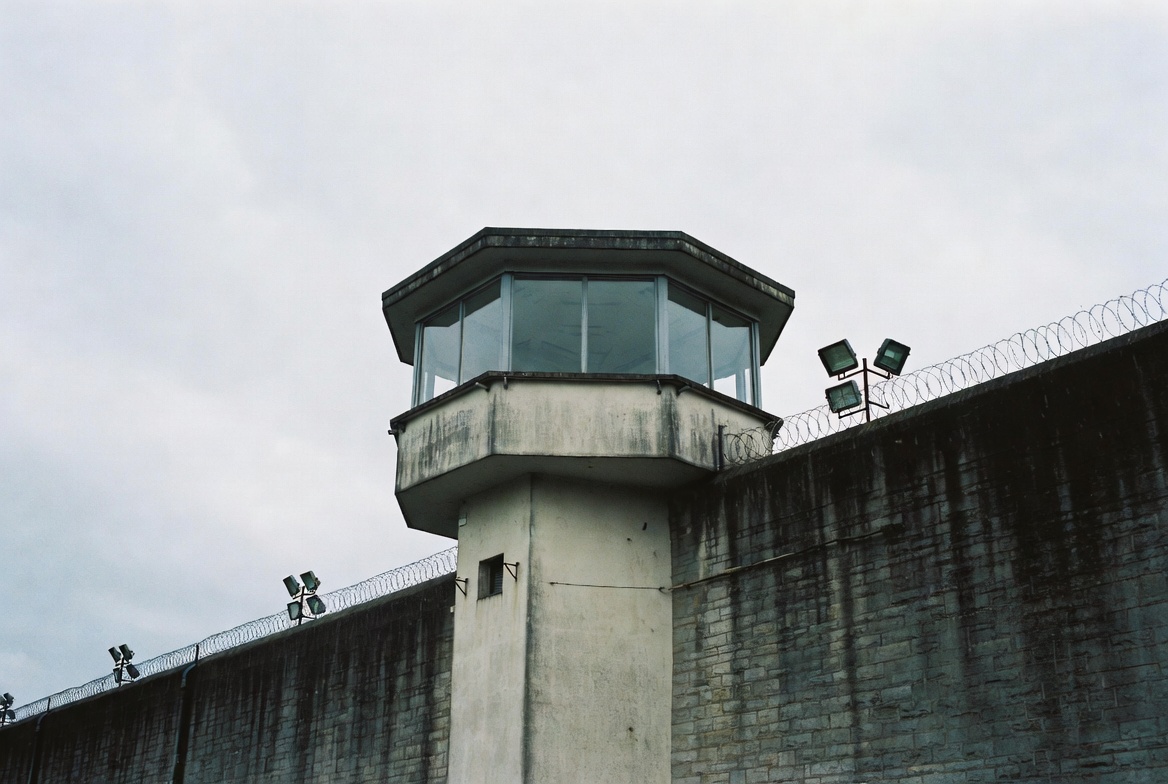
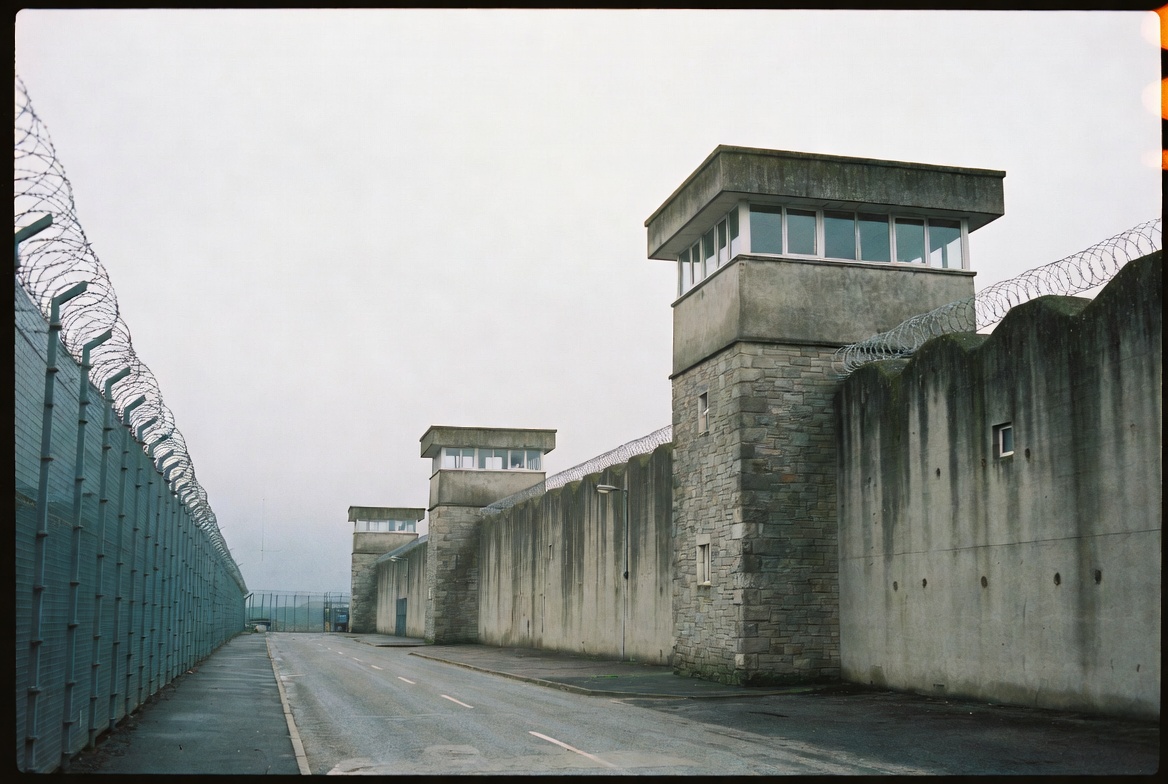
Portlaoise Prison stands a few minutes' walk south of the town centre, behind concrete walls topped with razor wire and overlooked by watchtowers. Until 2024 those towers were manned not by prison officers but by armed soldiers of the Defence Forces — a feature unique among the prisons of Western Europe.
From Maryborough to Portlaoise
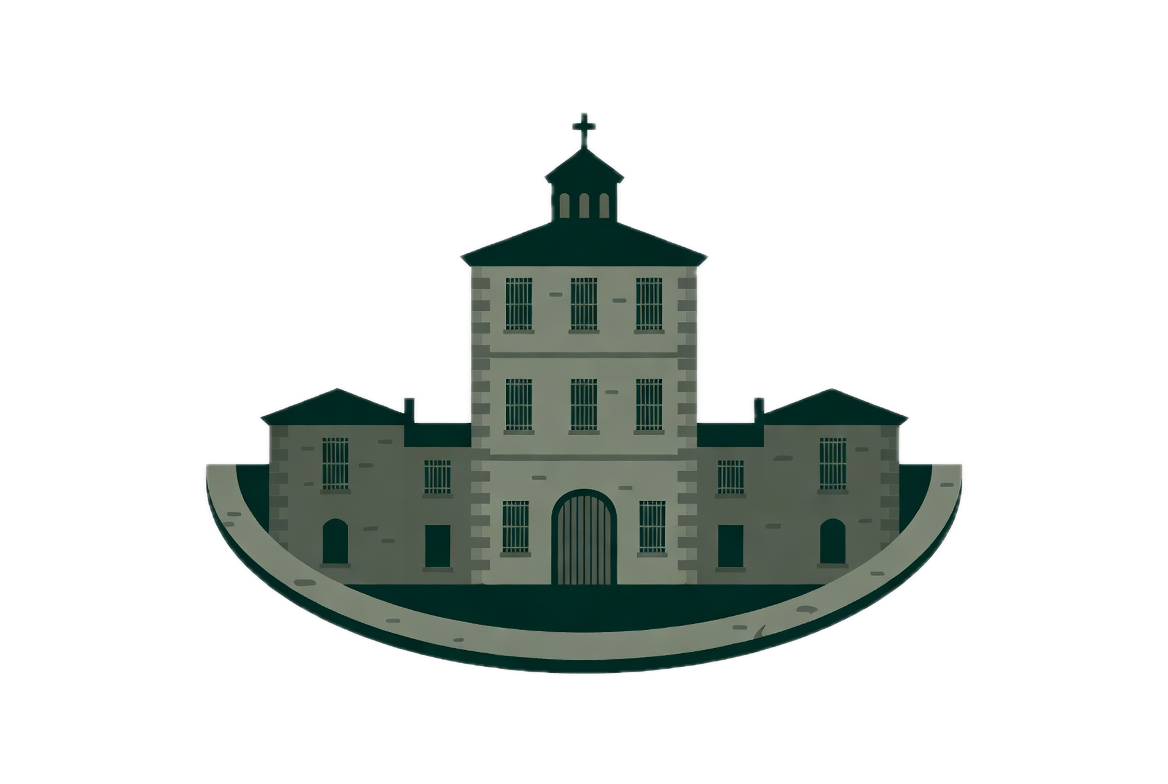
The prison opened in 1830 as the County Gaol of Queen's County and bore the town's then-official name, Maryborough Gaol. It was a typical Georgian county gaol of its period: an austere limestone block, a small chapel, separate accommodation for women and debtors, and a single execution shed. With the foundation of the Free State the town was officially renamed Portlaoise in 1929; the prison followed suit shortly after.
For most of the nineteenth and early twentieth centuries Portlaoise was an unremarkable middle-rank prison. That changed in the 1970s. As the Republic confronted a wave of paramilitary activity spilling south from Northern Ireland, the state needed a prison capable of holding men whose colleagues might attempt to spring them by force. Portlaoise — small, defensible, and located in the heart of the country — was selected.
The high-security era
From 1973 onwards Portlaoise was the designated home for prisoners convicted under Section 30 of the Offences Against the State Act 1939. The Defence Forces took up permanent station inside the perimeter. An air-exclusion zone of one nautical mile was declared overhead. Watchtowers were rebuilt in concrete; an inner cordon was added around the cell wings; helicopter landing was made physically impossible by overhead cables strung between the blocks.
There were repeated and serious escape attempts, all of them ultimately unsuccessful. In August 1974 nineteen IRA prisoners attempted to blow their way out using gelignite smuggled inside; all were recaptured within hours. A 1985 attempt involving a tunnel from the chapel was discovered before it broke the perimeter wall. A 2002 truck-ramming attempt fared no better.
The army withdrawal
The Defence Forces' permanent presence at Portlaoise — at peak, more than a hundred soldiers around the clock — was wound down through 2023, and in March 2024 the army formally withdrew from the prison's exterior perimeter. The Irish Prison Service now manages security entirely. The watchtowers remain. The air-exclusion zone has been lifted but the overhead cables stay.
The capacity of Portlaoise is 399, but the prison rarely operates near full. Its specialised role — paramilitary prisoners, organised-crime figures, men under specific threat — keeps the population well below the technical limit. The prison is not open to the public and never has been. There are no tours.
Notable inmates
- Seán McCaugheyIRA chief of staff; died after hunger and thirst strike, 1946
- Provisional IRA leadershipHeld in segregated wings throughout the Troubles
- Real IRA and Continuity IRA membersDetained from the late 1990s
- Organised-crime figuresIncreasingly held here from the 2000s onward