Captain Joshua Jebb of the Royal Engineers had already designed Pentonville when, in 1847, he was sent to Dublin to draw up a sister prison for Ireland. The new gaol opened on the North Circular Road three years later. It has scarcely closed a wing since.
Pentonville on the Liffey
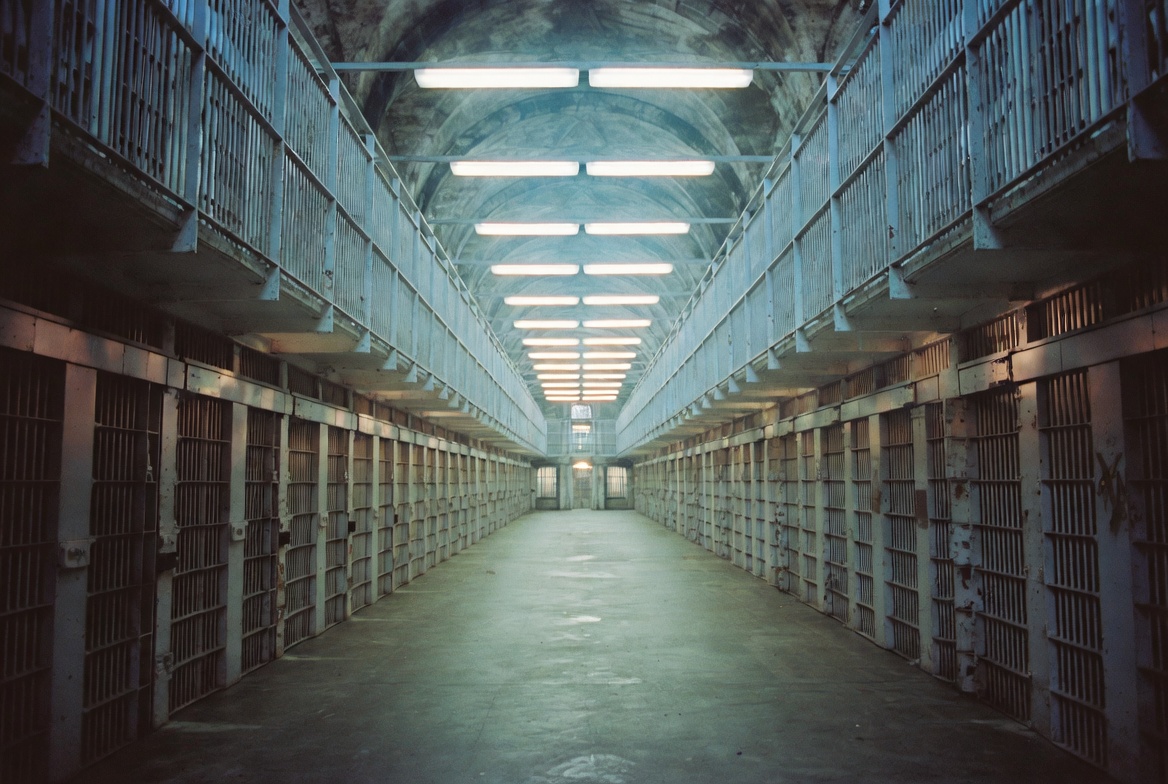
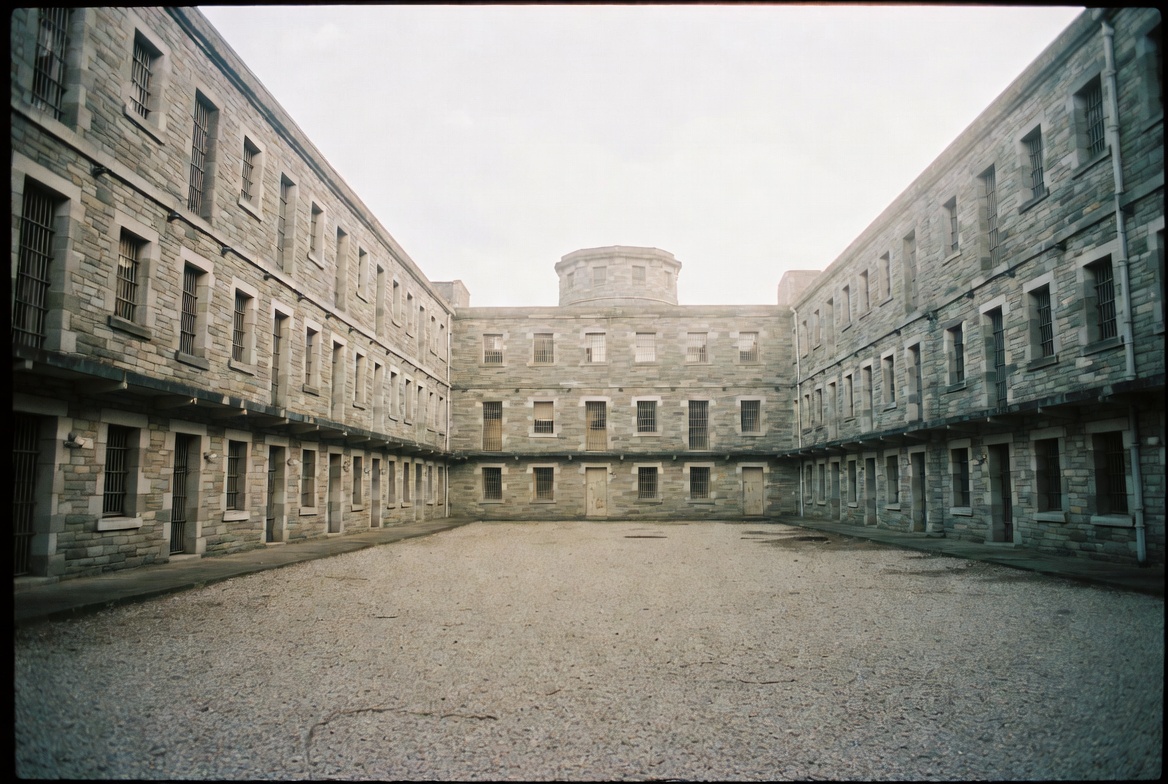
Mountjoy borrowed every architectural principle of Pentonville: a central rotunda, four radiating wings of single cells, glazed inspection galleries, and the so-called "separate system" by which prisoners were kept silent and unseen by one another. Each cell measured thirteen feet by seven, with a hammock, a small high window, and a piped-in air vent. The building was made of cut limestone and grey-painted iron. Its fire-proof, gas-lit interior was, in 1850, among the most advanced public works in Ireland.
The system was meant to be redemptive — silent labour, scriptural reading, and weekly chapel were thought to drive the convict toward repentance — but it was also harsh. Prisoners broke down. By the 1860s the rules had been relaxed; by the 1880s the separate system was effectively over. The architecture, however, remained, and it is essentially unchanged today.
The hanging shed
Forty-six prisoners were executed inside Mountjoy between 1901 and 1954. The hangings took place in a small purpose-built shed off D Wing, where a trapdoor opened over a brick-lined pit. Among the dead were Kevin Barry, eighteen years old, executed at eight in the morning on 1 November 1920 for his part in an IRA ambush on Church Street; Thomas Whelan and Patrick Moran, hanged together on 14 March 1921; and Annie Walsh, the only woman ever hanged in independent Ireland, executed on 5 August 1925 for the murder of her husband. The very last execution in the Republic took place here on 20 April 1954, when Michael Manning was hanged for murder. Capital punishment in the state was abolished — in practice — soon afterward, and formally in 1990.
Hunger strike and overcrowding
Mountjoy has been a political prison as well as a criminal one. Twenty Sinn Féin prisoners, including J.J. Walsh and Piaras Béaslaí, escaped from the gaol on 7 April 1919. Thomas Ashe, the Easter Rising veteran, died in custody in September 1917 after being force-fed during a hunger strike — his funeral cortège through Dublin numbered tens of thousands. In October 1923, almost five hundred republican prisoners began a mass hunger strike against internment without trial; it lasted forty-one days.
Today Mountjoy is the country's largest medium-security prison. Designed for around 480, it has held populations of more than a thousand in recent decades, and a 2017 inspector's report noted "chronic" overcrowding alongside ongoing refurbishment of the cell wings. Drugs, gangs, and inter-prisoner violence have replaced the silent system as the prison's principal management problem.
Notable inmates
- Kevin BarryExecuted 1 November 1920, age 18
- Thomas AsheEaster Rising veteran; died after force-feeding, 1917
- Brendan BehanPlaywright, IRA member; held here as a young man
- Constance MarkieviczHeld during the War of Independence
- Annie WalshOnly woman executed in independent Ireland, 1925
- Michael ManningLast execution in the Republic, 20 April 1954
- Antonin ArtaudFrench surrealist; briefly detained before deportation, 1937